
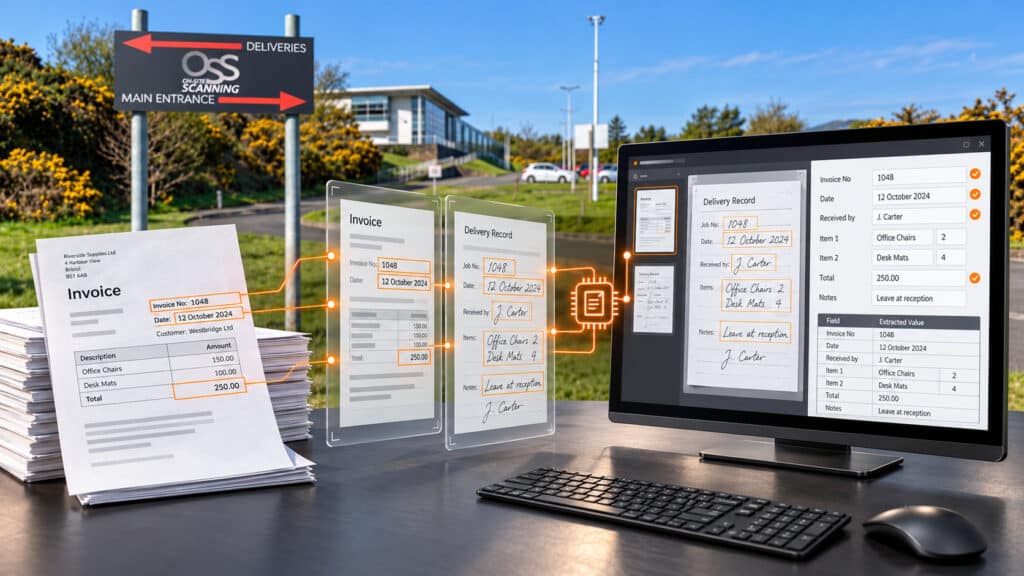
AI-Powered OCR Service
AI-Powered OCR and Clinical Summarisation
AI Powered OCR & Clinical Summarisation: Transforming How Healthcare Unlocks the Value of Its Records
AI driven Optical Character Recognition (OCR) has evolved far beyond traditional text capture. Modern intelligent OCR systems combine machine learning, handwriting recognition, clinical language understanding and advanced pattern analysis to convert any form of medical information—printed text, handwriting, forms, tables, historical notes and complex layouts—into structured, machine readable, clinically safe data.
This new generation of OCR doesn’t just read text. It understands context, structure and clinical meaning.
Accreditations and Certifications


Why AI OCR matters in healthcare
Across the NHS, handwritten notes remain deeply embedded in patient care. On average, 50% of a medical record contains handwriting, including:
- Clinical notes
- Forms and assessments
- Lab results
- Referrals
- Observations and risk indicators
- Traditional OCR cannot reliably interpret these documents. It struggles with:
- Handwriting
- Medical terminology
- Abbreviations
- Low quality scans
- Multicolumn layouts
- Tables and overlapping text
- Contextual meaning (e.g., mg vs mcg)
AI powered OCR overcomes these limitations, enabling healthcare organisations to digitise, search, analyse and utilise their legacy and incoming records with unprecedented accuracy.
The Power of AIDriven Handwriting Recognition
AI handwriting recognition unlocks the 50% of clinical information that traditional OCR cannot reach.
- Core Capabilities
- Accurate interpretation of handwritten notes
- AI models trained directly on medical records
- Full text searchable digital records
- Recognition of medical terminology and abbreviations
- Robust handling of tables, multicolumn layouts and overlapping text
- Context aware interpretation of clinical meaning
This enables entirely new possibilities for automation, safety and clinical efficiency.
Challenges in Healthcare That AI OCR Solves
Subject Access Requests (SARs)
- Currently require 8+ hours of staff time per record
- Create backlogs, financial strain and compliance risk
- AI automation dramatically reduces turnaround time and cost
Patient Record Summarisation
- Manual summarisation takes 4+ hours per record
- Creates clinical risk when delayed
- AI summarisation frees clinical time and improves safety
Medical Reports
- Often written directly by GPs
- Not core NHS clinical work
- AIassisted drafting returns valuable time to patient care
Value Opportunities
Immediate Value Opportunities
- Automated SAR processing
- AI assisted patient record summarisation
- AI generated medical reports
- Searchable digital archives
- Faster onboarding of patients into digital pathway
Near Term Value Opportunities
- Enhancing digital systems with OCR derived legacy data
- Meeting legal and compliance requirements faster
- Population health insights and metadata analysis
- Pattern recognition and anomaly detection
- Predictive and preventative medicine
- Personalised patient engagement
- Genomics and precision medicine enablement
- Enhanced R&D and drug discovery
Clinical Safety, Governance and NHS Alignment
Our platform is designed as a clinical decision support tool, not an autonomous clinical decision maker. It aligns with:
- DCB0129 (Clinical Risk Management – Manufacturer)
- DCB0160 (Deployment in NHS settings)
- DTAC clinical safety and data protection principles
- PRSB structured record standards
The System Ensures:
- No autonomous changes to live patient records
- No diagnostic or treatment recommendations
- Full traceability from summary to source document
- Clinician accountability for final acceptance
How the System Works
Handwriting Optimised OCR
Scanned handwritten records are processed using OCR tuned specifically for clinical handwriting and terminology.
Structured Clinical Extraction
Entities are extracted into defined domains such as:
- Active conditions
- Past medical history
- Medications
- Allergies
- Investigations
- Procedures
- Safeguarding indicators
- Mental health markers
- Risk factors
- Each entity receives a confidence score.
Controlled Language Model Summarisation
A constrained LLM generates a structured summary:
- Template driven
- Restricted to extracted content
- No external knowledge
- No speculation
- No autonomous judgement
Automated Safety Validation Layer
The system performs:
- Source to summary reconciliation
- High risk medication detection
- Mandatory allergy confirmation
- Safeguarding flag detection
- Low confidence OCR alerting
- Bidirectional traceability
- Summaries cannot be finalised until all required domains are addressed.
Ensuring Critical Information Is Never Missed
Patient safety is protected through:
- Deterministic entity extraction
- Mandatory domain coverage
- Automated omission detection
- Redflag checklist enforcement
- Confidence threshold gating
- Full audit logging
- Where required, summaries are provided as drafts for clinician review.
Security, Compliance and Data Protection
Our AI OCR and summarisation processes are built with security at their core:
- Encrypted processing environments
- Digital audit trails and traceability
- Compliance with GDPR, HIPAA and NHS DSPT principles
- ISOaligned hosting environments
- Strict datapurpose limitation
- Preservation of legacy records
- Improved interoperability and data quality
Clinical and Operational Benefits
For NHS organisations, AI powered OCR and summarisation deliver:
- Rapid digitisation of handwritten legacy notes
- Reduced clinician time spent navigating unstructured scans
- Improved visibility of allergies, medications and safeguarding risks
- Safer onboarding into digital pathways
- Better continuity of care
- Structured data for analytics and population health
The Future of AI OCR in Healthcare
AI OCR is not a single solution — it is a foundation for many solutions.
It enables automation, insight, safety and efficiency across every part of the healthcare ecosystem. From SARs to predictive medicine, from clinical summarisation to population health analytics, AI OCR unlocks the full value of the NHS’s historical and future data.
The question is no longer whether AI OCR will transform healthcare. It’s where else this technology can go next.

Talk to OSS about AI Powered OCR Solutions
If your organisation is sitting on handwritten legacy notes, or losing clinical time to manual data work, OSS can show you what AI OCR would do with your records. Fill in the contact form on our website, or call us on 01475 648 212, and we will talk through how it would fit your systems and your governance.
